
 Class 18.3 Steam Locomotive
39029
Gauge: HO Scale (1:87)
Class 18.3 Steam Locomotive
39029
Gauge: HO Scale (1:87)
Price: S$ 814.6771889644501
Advance order
Add to cart
Description
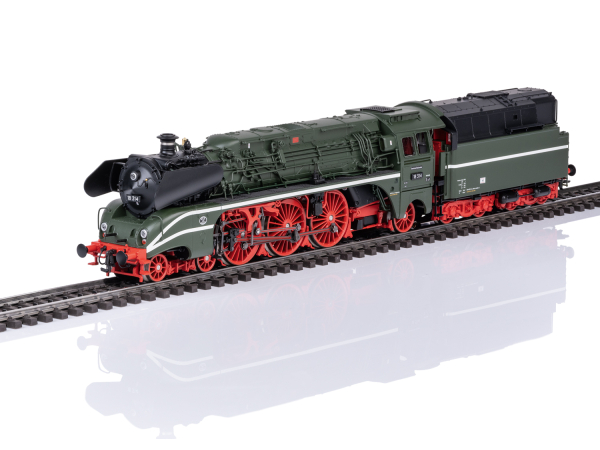
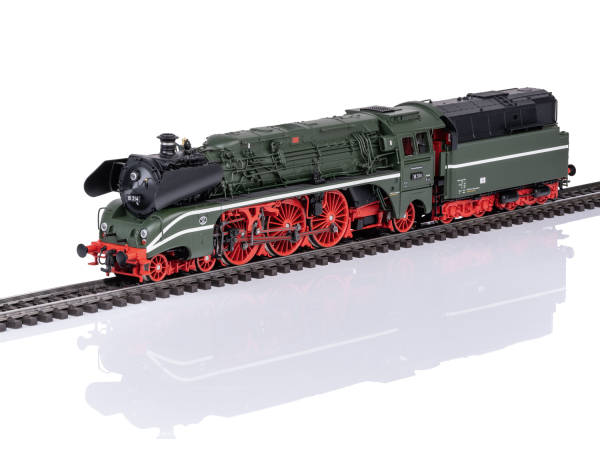
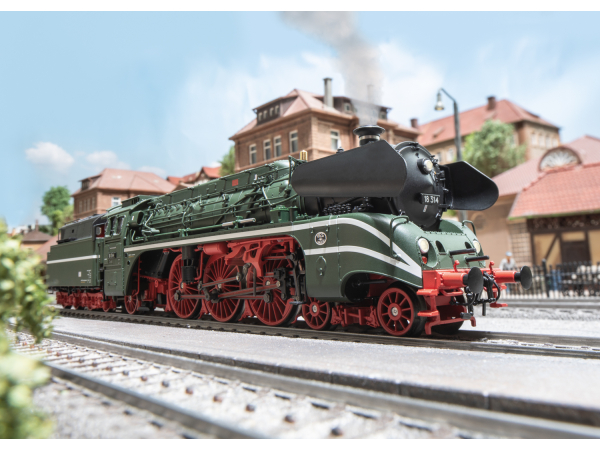
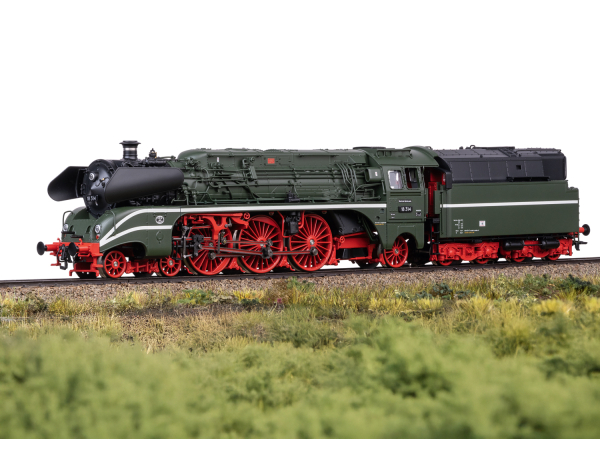
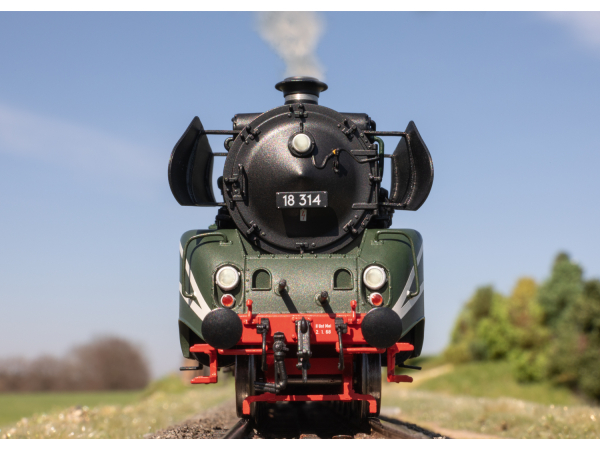
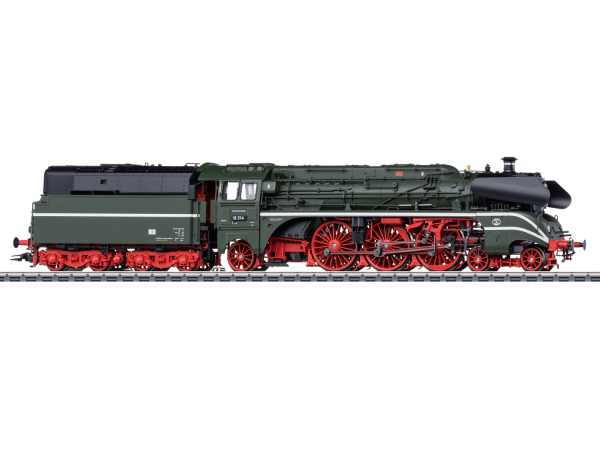
The Schorsch – a Unique One-of-a-Kind of the German State Railroad (DR).
“The German State Railroad (DR) of the GDR’s steam locomotive, road number 18 314—later affectionately called Schorsch—had a highly unusual and remarkable life story. Entering service in 1919 as a Baden Class IV h ‘High Stepper,’ it was taken over by the DRG as road number 18 314. After the end of World War II, the locomotive was exchanged for a Class S 3/6 in the Soviet Zone, where the newly formed VES-M Halle urgently needed a fast four-cylinder compound steam locomotive for experimental test runs.
In 1960, it was extensively rebuilt for higher speeds: it received a new reconstruction boiler, partial streamlining, a redesigned cab, a new tender, and a striking green paint scheme. Its conversion to oil firing in 1967 provided the finishing touch. Withdrawn from service at the end of 1971, the locomotive was placed into storage and eventually sold to West Germany in 1984. Since 1986, it has been on permanent loan from the HEF and remains one of the star exhibits at the Sinsheim Auto & Technology Museum.”
Prototype: German State Railroad of the GDR (DR/GDR) express steam locomotive, road number 18 314, with oil firing and a type 2´2´T34 oil tender. Conversion version as the experimental locomotive of the VES-M Halle (Saale). Version with a rebuilt boiler and partial streamlining, based on the steam locomotive, road number 18 314 (former Baden class IV h). Witte smoke deflectors and inductive magnet on one side. The locomotive looks as it did around 1968.
Highlights
- Especially intricate metal construction.
- A multitude of separately applied details.
- Factory-installed smoke unit with speed-dependent dynamic smoke exhaust.
- Cab lighting and running gear lights are digitally controlled.
- World of Operation mfx+ decoder with extensive operation and sound functions.
- Buffer capacitor included for bridging over short areas without current.
Model: The locomotive has an mfx+ digital decoder and extensive sound functions. It also controlled high-efficiency propulsion with a flywheel, mounted in the boiler. 3 axles powered. Traction tires. The locomotive and tender are constructed mostly of metal. There is a factory-installed smoke unit, speed-dependent dynamic smoke exhaust. The triple headlights change over with the direction of travel, will work in conventional operation, and can be controlled digitally. There are also two digitally controlled red lamps at the front of the locomotive. The cab lighting and the running gear lights can be controlled separately in digital operation. Maintenance-free warm white and red LEDs are used for the lighting. There is a buffer capacitor. There is a close coupling with a guide mechanism between the locomotive and the tender. There is a close coupler with a guide mechanism and an NEM pocket on the tender.
The minimum radius for operation is 360 mm / 14-3/16. Streamlining without a wheel cutout for installation beneath the cab is included for large radius curves or a display case. Piston rod protective sleeves and brake hoses are also included.
Length over the buffers 27.2 cm / 10-11/16.
