

Description
Through the History of Märklin Catalog Covers.
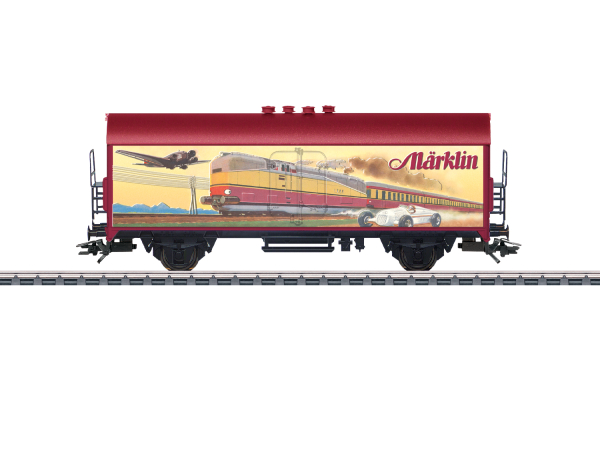
The artwork on this model freight car illustrates the richness and technical diversity of the Märklin product range from days long past. A fitting title might well be: “Rails, Roads, Air — All from Märklin!” Under the broad theme of transportation and traffic — combined with speed and the spirit of technological progress — Märklin’s dream factory created, and still creates today, a captivating miniature world that reflects the real one.
The train depicted in the artwork is unmistakably the Henschel-Wegmann express train, hauled by the legendary locomotive 61 002. Large parts of this locomotive survive today in the equally iconic express locomotive 18 201. Interestingly, the color scheme of both the locomotive and the trainset coincides with that of the famous 1928 Rheingold consist.
At the time this painting and the catalog it adorned were created, the Henschel-Wegmann train had just been introduced by the German State Railway (DRG). Märklin had planned to produce an 0-gauge model of this express train, but it never came to market — most likely due to the turbulent global events that followed shortly thereafter. However, a complete handmade sample, fully painted and lettered, was produced. An item number had even been assigned:
SHW 70/12920 — SHW standing for “Henschel-Wegmann Express Train.”
This sample train can be admired today at the Märklineum in Göppingen.
Racing alongside the express train on the parallel road is the famous Mercedes-Benz Silberpfeil (Silver Arrow). At the time, a version of the Silver Arrow could be built from Märklin’s metal construction kits — essentially a “do-it-yourself” model for budding young engineers.
A closer look at the painting also reveals the telegraph poles and their numerous lines on the left edge of the image. The many insulators and wires highlight the importance and prestige of the railway line on which our express train is traveling — unmistakably a main line, likely its originally intended route from Dresden Main Station to Berlin Anhalter Bahnhof.
In the sky above the train and automobile flies a Junkers Ju 52, which also appeared in the Märklin product line of that era and undoubtedly “flew” many routes in the playrooms of children at the time. One might wonder: did this model inspire some young players to become pilots one day?
Prototype: Privately owned type Ibopqs refrigerator car with the title image of the Märklin catalog from 1936. Model: Separately applied roof vents as well as separately applied ladders on the ends.
Length over the buffers 13.4 cm / 5-1/4.
